
Song Pairings: Toumast Tincha (Tinariwen), Tahra a Issasnane (Terakraft), Tamiditine (Bombino), Arrabi el Arabe (Mariem Hassan), Baraka (Aziza Brahim).
Playlist Link: https://open.spotify.com/playlist/0EDdKgXqpw9IvOjGb20dZ7?si=71f680f47c0045fe
Key Words: Sahara, Ethnic, Traditional, Blues, Guitar, Displacement, Colonialism, Rebellion.
The Sahara is the world in its extremes, and within the vast reaches of its deserts, hosts a remarkably diverse range of ethnic groups. The desert spans 3.6 million square miles from Western Sahara and Mauritania to Egypt and Sudan, and hosts a population density of less than one person per square mile. To call the Sahara scarcely populated is hardly a revelation, yet the vast oasis of musical traditions born from the sand speak volumes about the depth of life within a seemingly arid space.
Attempting to cover the entirety of Saharan music within one article would be an unrealistic task, so although it feels like a great injustice, this first edition will address a small section of the region’s many musical forms. This, however, necessitates a future second edition that will cover North African musical traditions that this edition cannot. As the true historical pioneers of Desert Blues, or ⵜⵉⵛⵓⵎⴰⵔⴻⵏ in Neo-Tifinagh script, the music of the Tuareg People is the perfect place to start.
THE TUAREG

Also known as the Blue Men of the Sahara, the Tuareg were among the first ethnic Saharan groups to combine Arab and North African sounds, birthing a genre now known as Tishoumaren, or Assouf. The origins of these musical traditions are inextricably linked to the ethnic groups from which they emerged. The Tuareg have had to adapt to the harsh conditions in which they have survived, and to vast periods of colonial occupation. The imposition of French colonialism in the late nineteenth century changed their societal structure, and in response, multiple-decade periods of raiding and violence ensued until 1917 when the French crushed their rebellions (see Alesbury 2013). Phonographic recordings of Tuareg music date back to Zoehrer expedition of 1935, yet the prominence of the guitar (the central instrument to all Tishoumaren) did not arrive until the mid- to late twentieth-century (see Standifer 1988). The pre-colonial and colonial development of Tuareg societies comprise a major part of their histories, yet unpacking this entire timeline would require many separate articles and I am a student slightly short on free time. The pioneers of modern Tuareg music will therefore be today’s focus.
Only recently has modern Tishoumaren been thrust into global limelight, with bands such as Tinariwen (ⵜⵏⵔⵓⵏ) rising to levels of fame that Saharan groups have seldom seen before. Tinariwen have been together since 1979, yet it was not until their album, The Radio Tisdas Session (2001), that their music became well known outside of whence it came. Their albums Kel Tinariwen (1992) and Ténéré (1998) attracted relatively little attention, mainly because Saharan music had not yet benefited from digital distribution at the time and because there was little enthusiasm for music written in the local Tamasheq language. Tinariwen’s rise to fame as the most prominent Tuareg band has been bolstered by their continual release of albums, with their most recent album Idrache (Traces of the Past) (2024) receiving mass critical praise. (They are also playing at the O2 Kentish Town Forum in May…)
Inspired by the trailblazing sound of Tinariwen, a novel Tuareg band was formed in 2001 that sought to sculpt a sound of peace from the searing air: Terakraft (ⵜⴻⵔⴰⴽⵔⴰⴼⵜ). Strongly biased as I am, since they are my favourite Tuareg band, I believe that Terakraft (meaning “caravan” in Tamasheq) have perfected a genuinely Saharan sound without emulating their legendary predecessors. Their two most acclaimed albums, Akh Issudar (2008) and Aratan n Azawad (2011), embody a gritty and unrefined tone that echoes the Tuareg’s four-thousand-year struggle for survival in the desert. The electric guitar underpins Terakraft’s entire discography, yet unlike Tinariwen, the band does not aim to air a sound of rebellion but one of peace for their people.
Alongside Tinariwen and Terakraft, Nigerien singer-songwriter Bombino (ⴱⵓⵎⴱⵉⵏⵓ) has remained a central figure in Tuareg music since his first solo album, Agamgam 2004 (2010, but originally 2004). Bombino has released eight studio albums which have all been critically admired far beyond the Sahara, and is the first person from Niger to have been nominated for a Grammy. Bombino’s story is one born out of flight, having been forced to flee to Algeria during the Tuareg Rebellion (1990). It was during this period of uncertainty, however, that he learnt to play guitar. Bombino was inspired by rock greats such as Mark Knopfler and Jimi Hendrix, delivering a distinctly familiar sound within a distinctly unfamiliar genre. Tinariwen, Terakraft, and Bombino represent only a tiny slice of Tuareg music, so expect a future edition that covers other similarly iconic Tuareg bands and artists.
I’d love to endlessly write about Tuareg music, but the music of the Sahrawi People is both too good to miss out and too influential to ignore. There will be, however, a Spotify playlist provided to include the best of all Desert Blues. A master-sheet if you will.
THE SAHRAWI
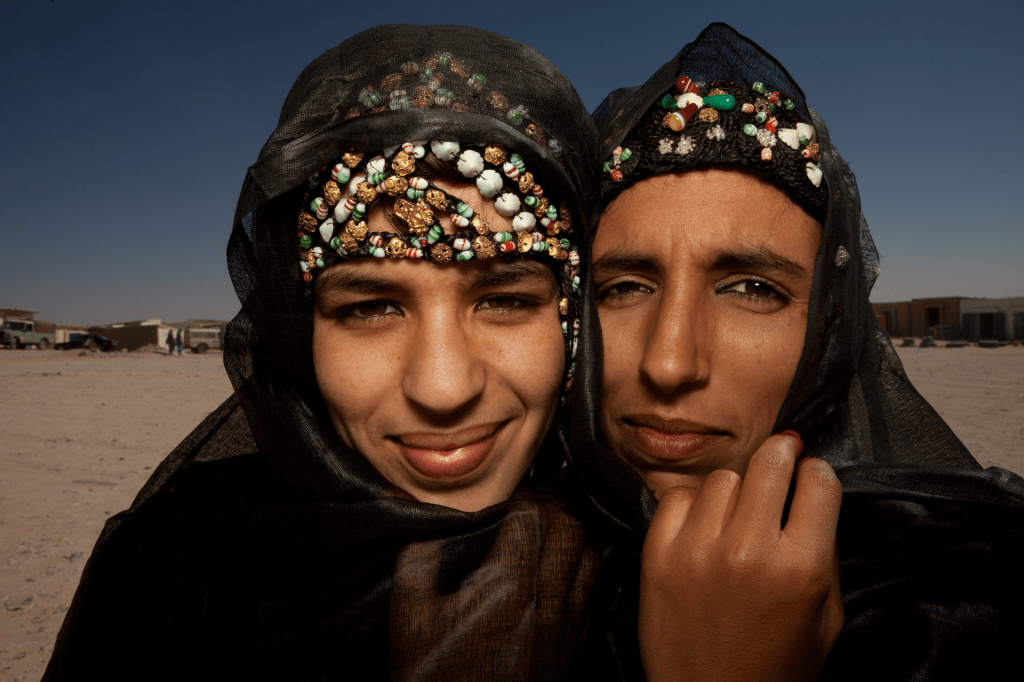
The Sahrawi people are a nomadic group native to the western reaches of the Sahara, mainly in Western Sahara, southern Morocco, and parts of Mauritania and Algeria. Their roots lie in a mix of Arab and Berber ancestry, shaped over centuries of desert life defined by trade and herding. For generations, the Sahrawis moved across the desert following seasonal routes, their identity built around a shared language (Hassaniya Arabic) and deep pride in their independence (see Omar 2008). In the twentieth century, their history took a dramatic turn when Spanish colonial rule ended and Morocco claimed Western Sahara, sparking a long conflict and the displacement of many Sahrawis to refugee camps in Algeria (see Fynn 2011). Despite this, music and storytelling continue to play a central role in preserving their sense of belonging.
The Sahrawi music-scene has been shaped by decades of resettlement and exile, creating a style that seeks to uphold cultural resistance (see Posada 2015). One figure stands at the pinnacle of Sahrawi music and is largely responsible for the globalisation of North-West African traditional music: Meriam Hassan. Dubbed the “Voice of the Sahara”, Hassan was born near Smara (present day Western Sahara) and became known for blending traditional Sahrawi music with modern styles to tell stories of exile. Although she had released two albums in the 2000s, Deseos (2005) and Shouka (2009), it was her 2012 album El Aaiun Egdat that saw her become a seminal figure of North-West African resistance music. Just as Tinariwen and Terakraft incorporated the electric guitar into their sound, Hassan’s common saxophonist accompaniment is representative of Western popular music’s influence on the African Continent. Hassan is not alone in her position of influence among Sahrawi artists, however.
Aziza Brahim is also widely recognised as a leading mouthpiece for Sahrawi struggle. Brahim was born in 1976 in an Algerian refugee camp after her family fled the conflict in Western Sahara. Growing up amid displacement, she turned to music as a way to express the pain of her people, and her first digital album Mi Canto (2009) was quickly ranked number one across world music rankings. Like Meriam Hassan, however, it was her later album Soutak (2012) that propelled her into international recognition. Brahim is not only seen as a Sahrawi icon, but as a major North-West African feminist figure. Since her life and music embody the strength and agency of Sahrawi women in the face of displacement and patriarchal structures, Brahim’s work is embedded in African women’s rights.
In Sahrawi music, there is a sub-genre where the influence of Spanish colonial rule is distinctly audible. Artists such as Hafed Mayub even title their songs or write their lyrics in Spanish. The combination of classically West African guitar fused with Spanish lyrics and musical themes forms a unique sound that reflects how colonial legacies remain prevalent in creative mediums.
These examples from Sahrawi and North-West African music only scratch the surface of how rich and varied the region’s sound is. They show how artists carry memories of displacement and colonial history through their music. For the sake of brevity, however, it is here that Edition 1 comes to a close. Although I’ve only touched on two corners of a much wider African musical landscape, I hope the bands, artists, sub-genres, and stories mentioned so far give you a starting point to dig further on your own. As this is the first of many articles, any feedback or criticism is welcome. As for an account of my recent trip to Mhamid El Ghizlane in the Moroccan Sahara, that’s reserved for the future Part 2 of the Desert Blues Edition.
Below, I attach a list of my favourite bands/artists under the umbrella of Desert Blues for your interest. Additionally, links for further reading are provided alongside references.
Thank you for reading this first edition of POLYJAMORY.
-Artie
16/11/2025
Favourite Bands:
Tinariwen, Terakfraft, Imarhan, Tamikrest, Daraa Tribes, Tarwa N-Tiniri, Sarah & Ismael, Tartit, Les Filles de Illighadad, El Wali, Génération Taragalte, Jeunesse du Désert, Zagoband, Izouran N’Sahara, Kel Dades, Etran Finatawa, Toumast, and Kel Assouf.
Favourite Artists:
Bombino, Aziza Brahim, Hafed Mayub, Said Taragalte, Mariem Hassan, Blick Bassy Boubacar Traoré, Victor Démé, Habib Koité, Ali Farka Touré (father of Vieux Farka Touré), Samba Touré, Afel Bocoum, Oumou Sangaré, Nayim Alal, Faris, and Alhousseini Anivolla.
Further Reading:
https://web.archive.org/web/20130603113136/http://www.cumbancha.com/bombino-biography-eng/
https://journals.sagepub.com/doi/pdf/10.1177/0020702013505431
https://www.jstor.org/stable/1783387
https://www.songlines.co.uk/features/essential-10/touareg-albums-the-essential-10
References:
Alesbury, Andrew. 2013. “A society in motion: the Tuareg from the pre-colonial era to today.” Nomadic peoples, 17.1, pp. 106-125.
Fynn, Veronica. 2011. “Africa’s last colony: Sahrawi people–refugees, IDPS and Nationals?.” Journal of Internal Displacement, 1.2, pp 40-58.
Omar, Sidi M. 2008. “The right to self-determination and the indigenous people of Western Sahara.” Cambridge Review of International Affairs, 21.1, pp. 41-57.
Posada, Violeta Ruano. 2016. “Portraits of Saharawi Music: When Cultural Preservation Meets Political Activism.” African Music: Journal of the International Library of African Music, 10.2, pp. 109-125.
Standifer, James A. 1988. “The Tuareg: their music and dances.” The Black Perspective in Music, pp. 45-62.
About the Author:
I am an MPhil in African Studies student at the University of Cambridge with a specific research interest on the role of musical resistance in the South African struggle against apartheid between 1960 and 1980. I hold a BA in Theology & Religion from Durham University, where my research explored how North West African funerary music impacted the birth and rise of Rastafarian reggae music in Jamaica during the 1930s and beyond.
 POLYJAMORY
Leave a comment